

Despite the name, you can run a close at any time of the month, as often as you like. It runs on demand for whichever month you pick, so you can check an in-progress month mid-month, re-run after fixing something, or close a month from last quarter. Nothing about it is tied to the calendar rolling over.
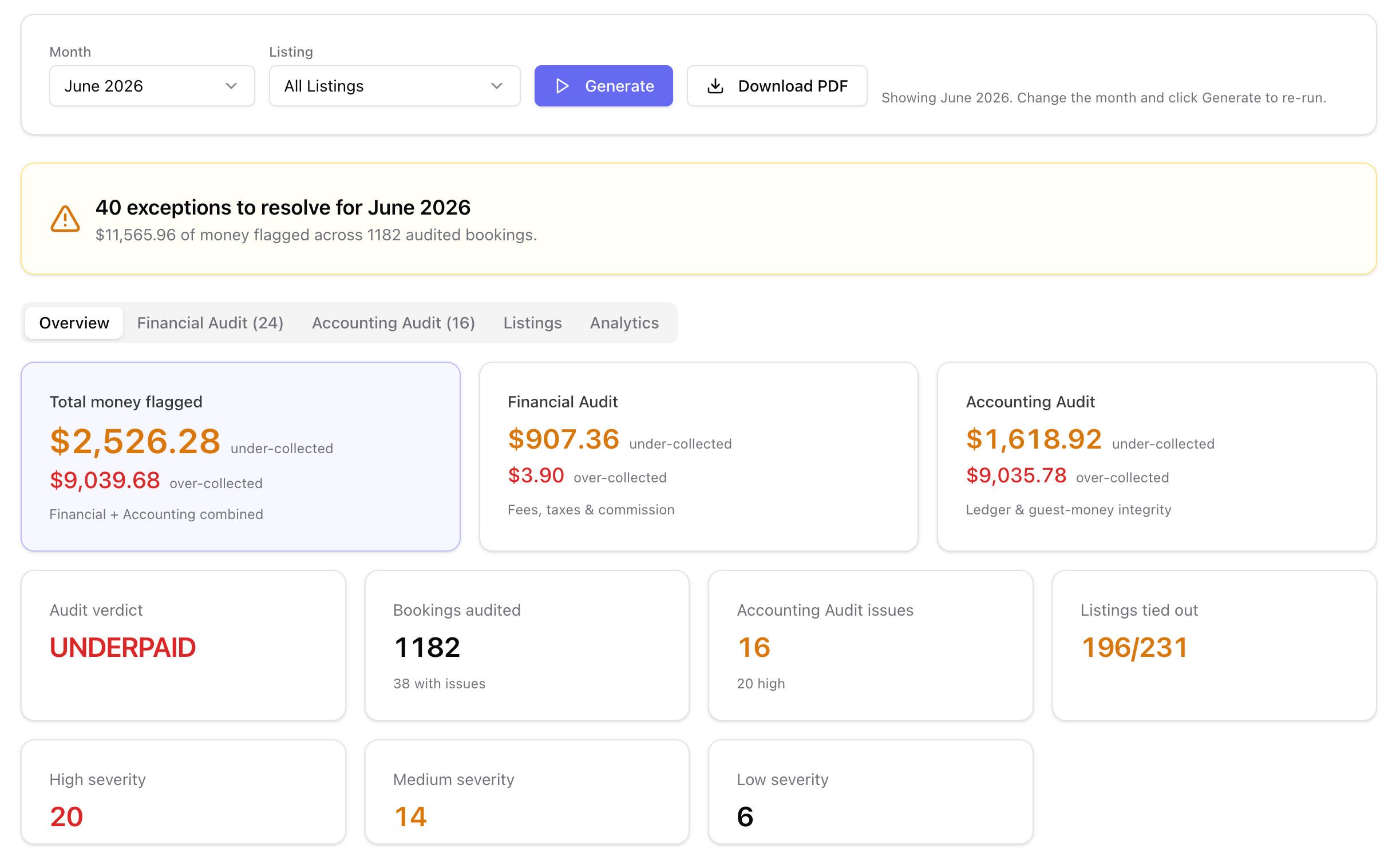
Month-End Close after a completed run
Month-End Close is on for all accounts by default. If the sidebar entry is missing, it has been disabled for your user - contact support. PX sends you back to Home if you open the page directly while it is disabled.
Running a close
The controls sit in a card at the top of the page:- Month - the month to close.
- Listing - a single property, or All Listings (the default).
- Generate - starts the run. The button reads Running… while it works.
<month>. Change the month and click Generate to re-run.
Download PDF
Download PDF appears next to Generate after a run completes. The PDF is scoped to the month and the listing you selected, so a single-listing close exports that listing only.Reading the result
A banner at the top gives you the headline:
When a close fails, PX suppresses the numbers below the banner rather than showing zeros - an empty 0 flagged / CLEAN body under a red banner would read as a clean month. If Guesty rate-limited the request, wait a few minutes and click Generate again. Guesty applies both a per-minute throttle and a daily authorization cap, and the daily cap clears in hours rather than minutes, so the message tells you which one you hit.
Warnings that qualify a result
These appear above the tabs and mean the numbers are incomplete rather than clean: Some listings could not be audited - the close is partial and may understate leakage. Ledger checks did not run - Guesty reports no Accounting Add-on for the account, so journal entries could not be read. Re-running will not help; the add-on has to be enabled in Guesty. Ledger checks were skipped for some reservations - a journal-entry fetch failed. Re-run to complete them. The audit window could not be trimmed to this month - the audit and diagnostics may cover different date ranges. Config sync incomplete for this close - the point-in-time rate history did not fully reconcile, so a recent fee, tax, or markup change may not be reflected. Re-run the close; if it recurs, check the configuration sync.Overview tab
Three money boxes split the exposure, and the total is exactly the other two added together:- Total money flagged - Financial + Accounting combined.
- Financial Audit - fees, taxes and commission.
- Accounting Audit - ledger and guest-money integrity.
Financial Audit tab
The full Financial Audit results table for the month, identical to the one on the Financial Audit page - see Audits overview for how to read it. Column preferences here are stored separately, so you can lay the two tables out differently.Accounting Audit tab
Reservation and folio integrity issues for the month. Four cards sit above the list: Unresolved and Fix in Progress for this close, plus Total Issues (All Time) and Fixed (All Time), which are running account totals rather than monthly figures. The list itself defaults to Open only so it shows outstanding work. You can mark issues fixed, start a fix, dismiss, or reopen them from this tab, one at a time or in bulk. Resolving an issue removes it from the exception counts and the money flagged for this close, so the headline banner and the Overview figures update as you work. See Accounting Audit for the filters, the bulk actions, and how to read an individual issue.If you have no business models configured, this tab prompts you to set them up. Revenue-recognition and fee-allocation checks cannot run without them. See Business models.
Listings tab
A sortable per-listing breakdown, so you can see which properties account for the month’s exposure.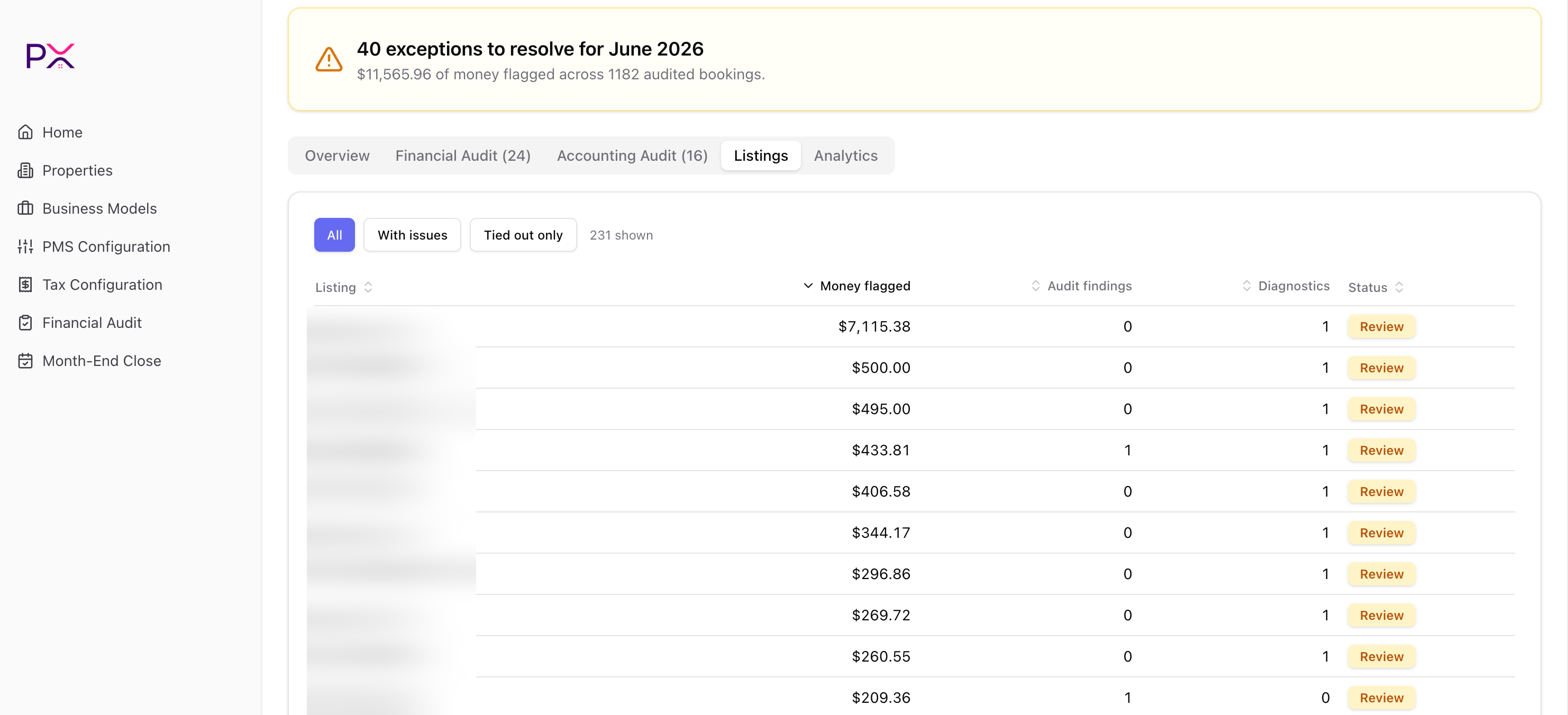
The Listings tab, sorted by money flagged
Click any column header to sort. The table opens sorted by Money flagged, descending, which puts your largest problems first.
A listing can show Review with zero Audit findings: one Accounting Audit issue is enough to hold it open. Check the Diagnostics column before assuming a clean Financial Audit means a clean listing.
Analytics tab
Five charts over the same month.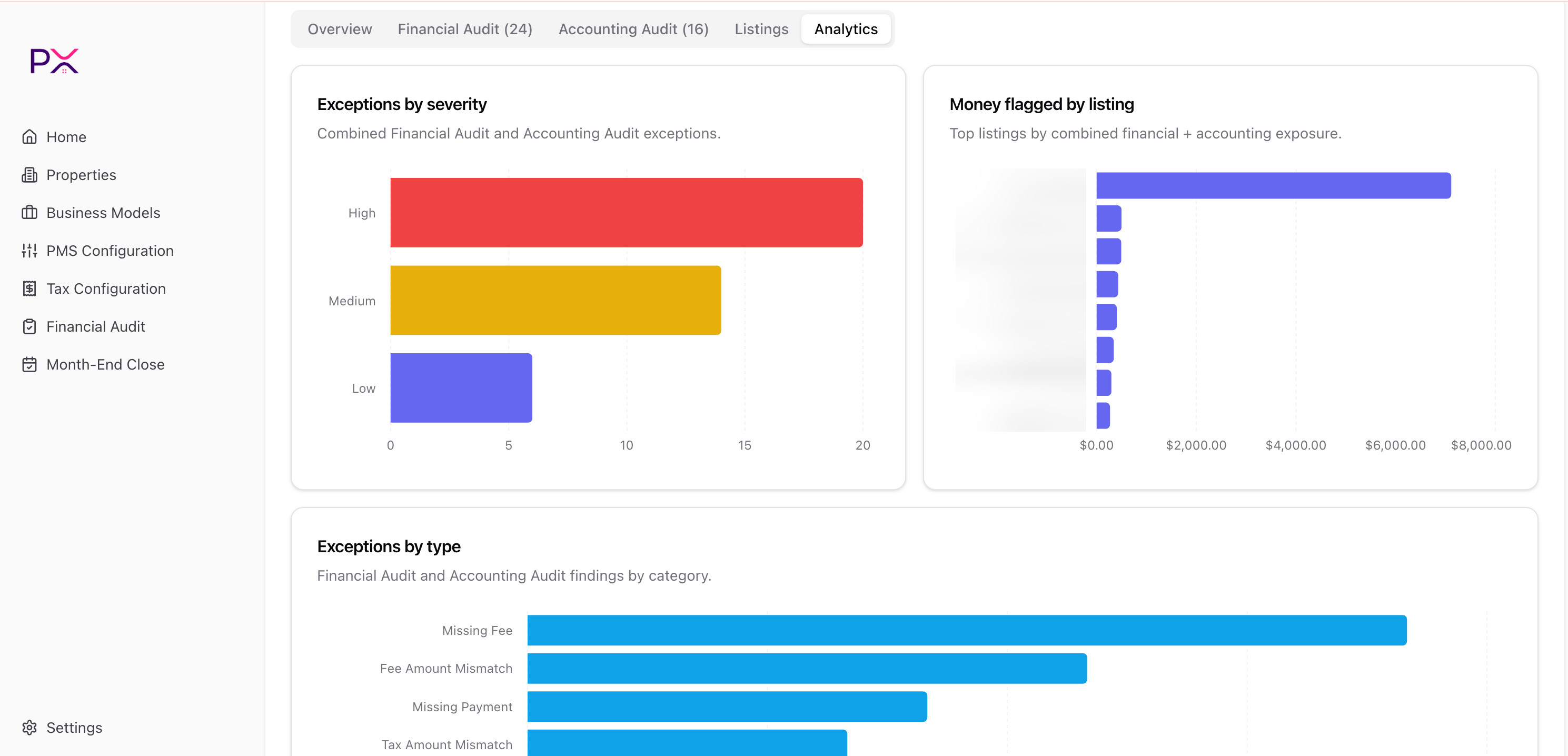
Exceptions by severity and money flagged by listing
- Exceptions by severity - combined Financial and Accounting exceptions, split high / medium / low. These are the same counts as the severity tiles on the Overview tab.
- Money flagged by listing - your most exposed listings, ranked by combined financial and accounting exposure. Useful for deciding which property to work first.
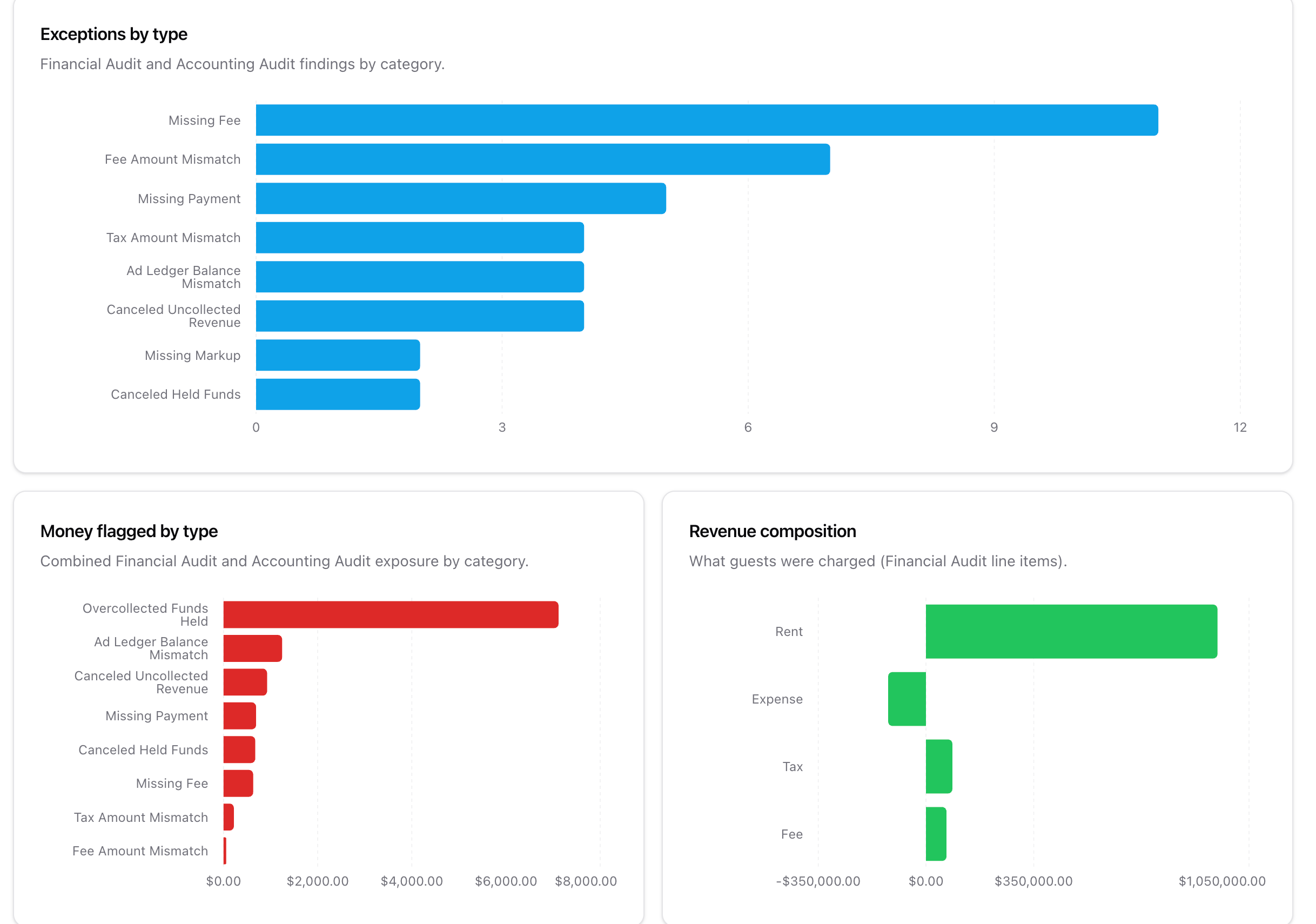
Exceptions by type, money flagged by type, and revenue composition
- Exceptions by type - findings by category across both audits, so you can see whether the month is dominated by one recurring problem. Categories are the human-readable check names, such as Missing Fee, Fee Amount Mismatch, Missing Payment, Tax Amount Mismatch, Ad Ledger Balance Mismatch, or Canceled Uncollected Revenue.
- Money flagged by type - the same categories ranked by dollars rather than count. The two often disagree: the most frequent exception is rarely the most expensive one, so read them together before deciding where to spend time.
- Revenue composition - what guests were charged, from Financial Audit line items, broken into Rent, Expense, Tax, and Fee. Expenses plot to the left of zero because they reduce what reaches the owner, so the axis runs negative as well as positive.
What’s next
Understanding findings
How to read an individual finding.
Check categories
What each class of check looks for.